How Long Will a Mother Deer Leave Her Baby Alone?
 The California Mule deer and Black-Tailed Deer are closely related deer whose range covers much of the state of California.
With rapid development of rural areas, deer are losing their natural habitats and are forced farther into suburbia. They now alive close to our homes and towns. In a earth where contact with wildlife is more than frequent, we may need to change some of our behavior to find ways to alive with them. To coexist with deer, they must exist understood.
Spring and summer is the time of year deer give birth to their young. A deer may have between one and 3 babies, two being nearly mutual. Fawns are born from April though June. They are born with their eyes open and fully furred. The fawn is able to stand in 10 minutes and tin walk in vii hours. Immature fawn stay with their mother through next winter.
Healthy babe fawns are daily left alone by their mothers while the mothers fodder for food. Unfortunately, many times a solitary fawn is picked upwards past people who mistakenly think the fawn has been abandoned. The fawn is then brought to Native Animal Rescue by the "well meaning" people for rehabilitation. Sadly those fawn have been taken from the mother unnecessarily. In other words, they were kidnapped.
Kidnapped fawns should be immediately returned to the exact location where they were establish and the left alone. The mother will return and always take her infant back. If all the same you do non go out the fawn lone, the doe will non return to her baby as she will sense danger. Once she senses the potential danger is gone, she will and then rejoin her young.
Think, if you run into a fawn lying quietly in the forest, practice not disturb. Mom is nearby and will go back to her babe when yous are gone.
The only time a fawn should be picked up and brought to NAR is if it is obviously ill or injured.
If a fawn is wandering aimlessly and crying, that may be an indication the mother may have been hurt and will not return. Phone call Native Animal Rescue for advice.
The fawnʼs natural predators are cougars, coyotes, bobcat and domestic dog packs. It is of vital importance that we keep our dogs contained to forbid needless dog attacks on fawn as well as other wildlife. Too ofttimes Native Animal Rescue receives injured deer due to attacks by dogs. Almost of those injured deer do not survive. In that location is a leash police force in Santa Cruz Canton and so it is of the upmost importance to abide by the law and go on dogs confined to their own territory. Doing so volition help preclude attacks on our defenseless native wildlife.
Fawns are built-in smell-free and have white camouflage spots which protect them from predators. The doe continues to keep her babies odor gratis by consuming her fawns urine and debris. This is nevertheless another reason why humans should never touch a fawn. Leaving human odor on their body will attract predators to the fawn. If you lot have touched a fawn and are returning the fawn to the place where constitute, please do the following:
- Put on rubber gloves and get a towel.
- Rub the towel in the grass and so wipe the fawnʼs body with that towel to remove human being scent.
- Leaving the gloves on, render the fawn to the place where found. Now the fawn is once once again scent-free and waiting for mom to return.
The destruction of habitat through logging and evolution has played a large function in the subtract of deer. Sadly, automobiles destroy thousands of deer annually. The following are a few tips on how to make your drive safer for yous and the deer:
- Listen wild fauna alert signs and adhere to the speed limit.
- Where forest or fields are on both sides of the route, browse for wild fauna at all times. Be particularly circumspect during dawn, dusk, and nighttime hours.
- At nighttime, always sentry for reflection from the eyes of deer and other nocturnal animals.
- If a deer "freezes" in your head lights, terminate if safety and turn your headlights off and on and so the creature can pass.
- When you run across brake lights, it could mean the driver ahead of you has spotted deer. Stay alert!
- If one animate being crossed the road ahead of yous, stop and picket; in that location will probably be others.
- Deer hooves slip on pavement. A deer may autumn in front of your vehicle but when you retrieve it's jumping abroad.
- If you accidently hit and kill a deer, move information technology far off the road. Often a doe will be killed and her fawn is withal there in harms mode. The living fawn/s will stay by their dead mom and/or dead sibling for hours.
- If an developed deer is hitting past a vehicle and wounded, immediately telephone call Santa Cruz Canton Animal Services (831-454-7200) or the non-emergency number of the local law for assistance. Please do not let the deer suffer.
- Practice not touch an injured deer as their sharp hooves will practise major harm to you.
Deer of are such beautiful creatures to observe, merely if you lot do not desire them in your garden, hither are some helpful hints to humanely keep them away:
- Fruit copse are a natural attractant. Fruit should be harvested and fallen fruit removed.
- Grass and underbrush should be kept trimmed.
- Attractants can be surrounded by repellant plants such as: catnip, chives, garlic, lavender, onion, sage, spearmint and thyme.
- Visual stimuli like strobe lights, mylar tape, scarecrows, bright lights, motion activated h2o sprays, loud noises and radios volition help keep the deer away.
- Deer fencing at to the lowest degree viii feet high or just fencing individual plants.
If y'all encounter an adult deer with a broken leg or other injury, leave the brute alone unless it can't stand. Even though the injury may take a long time to heal, this is far preferable to the trauma of chase and capture. Wild animalʼs ability to heal and their adaptability of some injuries are quite astonishing.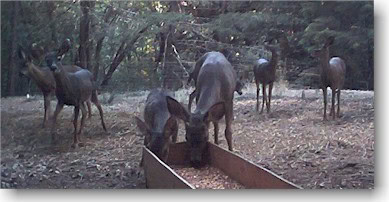
Being able to find deer and bask their incredible beauty, innocence and wildness is an unforgettable feel and privilege that we tin all relish.
For more than data on deer or any other wild animal, please call Native Animal Rescue at: 831-462-0720 and visit our website: www.nativeanimalrescue.org.
Written past:
Vikki Simons-Krupp
Native Animal Rescue
Wild animals Rehabilitator/Board Fellow member
Source: https://www.nativeanimalrescue.org/understanding-deer/
0 Response to "How Long Will a Mother Deer Leave Her Baby Alone?"
Post a Comment