Asexual Erotics: Intimate Readings of Compulsory Sexuality
Asexuality is the lack of sexual attraction to others, or low or absent-minded interest in or desire for sexual activity.[1] [2] [3] It may be considered a sexual orientation or the lack thereof.[4] [five] Information technology may also exist categorized more widely to include a broad spectrum of asexual sub-identities.[6]
Asexuality is distinct from abstention from sexual activity and from celibacy,[seven] [8] which are behavioral and generally motivated past factors such every bit an individual'southward personal, social, or religious beliefs.[9] Sexual orientation, different sexual behavior, is believed to be "enduring".[10] Some asexual people engage in sexual action despite lacking sexual attraction or a desire for sex, due to a variety of reasons, such every bit a want to physically pleasure themselves or romantic partners, or a desire to have children.[vii] [11]
Acceptance of asexuality as a sexual orientation and field of scientific research is yet relatively new,[2] [11] as a growing trunk of research from both sociological and psychological perspectives has begun to develop.[xi] While some researchers assert that asexuality is a sexual orientation, other researchers disagree.[4] [v] Asexual individuals may stand for nigh ane percent of the population.[2]
Diverse asexual communities have started to form since the bear upon of the Internet and social media in the mid-1990s. The well-nigh prolific and well-known of these communities is the Asexual Visibility and Didactics Network, which was founded in 2001 by David Jay.[four] [12]
Definition, identity and relationships
Asexuality is sometimes called ace (a phonetic shortening of "asexual"[xiii]), while the community is sometimes called the ace customs, by researchers or asexuals.[14] [xv] Because in that location is significant variation among people who identify as asexual, asexuality tin encompass broad definitions.[xvi] Researchers mostly define asexuality equally the lack of sexual attraction or the lack of sexual interest,[4] [11] [17] simply their definitions vary; they may use the term "to refer to individuals with low or absent sexual desire or attractions, low or absent sexual behaviors, exclusively romantic not-sexual partnerships, or a combination of both absent sexual desires and behaviors".[11] [18] Cocky-identification as asexual may besides be a determining cistron.[18]
The Asexual Visibility and Didactics Network defines an asexual as "someone who does non feel sexual allure" and stated, "[a]nother pocket-size minority will call back of themselves as asexual for a brief period of time while exploring and questioning their own sexuality" and that "[t]hither is no litmus test to determine if someone is asexual. Asexuality is like any other identity – at its core, it'south only a give-and-take that people apply to help effigy themselves out. If at any point someone finds the discussion asexual useful to describe themselves, we encourage them to use it for every bit long as information technology makes sense to do so."[19]
Asexual people, though lacking sexual attraction to any gender, might engage in purely romantic relationships, while others might not.[4] [xx] At that place are asexual-identified individuals who report that they experience sexual attraction merely not the inclination to act on information technology considering they have no truthful desire or need to engage in sexual or non-sex (cuddling, hand-belongings, etc.), while other asexuals engage in cuddling or other not-sexual physical activity.[7] [viii] [11] [16] Some asexuals participate in sexual action out of curiosity.[11] Some may masturbate as a solitary grade of release, while others practise not experience a need to do so.[xvi] [21] [22]
With regard to sexual practice in particular, the need or desire for masturbation is commonly referred to equally sex drive by asexuals and they disassociate it from sexual attraction and being sexual; asexuals who masturbate generally consider it to exist a normal production of the human torso and not a sign of latent sexuality, and may not fifty-fifty observe it pleasurable.[eleven] [23] Some asexual men are unable to go an erection and sex by attempting penetration is impossible for them.[24] Asexuals also differ in their feelings toward performing sex acts: some are indifferent and may accept sex for the do good of a romantic partner; others are more than strongly averse to the idea, though they do not typically dislike people for having sexual activity.[11] [16] [22]
Many people who identify as asexual also identify with other labels. These other identities include how they define their gender and their romantic orientation.[25] They will ofttimes integrate these characteristics into a greater label that they place with. Regarding romantic or emotional aspects of sexual orientation or sexual identity, for example, asexuals may place equally heterosexual, lesbian, gay, bisexual, queer,[nineteen] [20] or by the post-obit terms to betoken that they associate with the romantic, rather than sexual, aspects of sexual orientation:[16] [20]
- aromantic; lack of romantic attraction towards anyone
- biromantic; by analogy to bisexual
- heteroromantic; past illustration to heterosexual
- homoromantic; past illustration to homosexual
- panromantic; by analogy to pansexual
People may likewise identify as a grey-A (such every bit a grey-romantic, demiromantic, demisexual or semisexual) considering they feel that they are betwixt existence aromantic and non-aromantic, or betwixt asexuality and sexual attraction. While the term gray-A may encompass anyone who occasionally feels romantic or sexual attraction, demisexuals or semisexuals experience sexual attraction only as a secondary component, feeling sexual attraction one time a reasonably stable or large emotional connection has been created.[16] [26]
Other unique words and phrases used in the asexual customs to elaborate identities and relationships also exist. Ane term coined by individuals in the asexual community is friend-focused, which refers to highly valued, non-romantic relationships. Other terms include squishes and zucchinis, which are non-romantic crushes and queer-platonic relationships, respectively. Some asexuals use ace playing menu suits as identities of their romantic orientation, such as the ace of spades for aromanticism and the ace of hearts for non-aromanticism.[xiii]
Terms such as not-asexual and allosexual are used to refer to individuals on the opposite side of the sexuality spectrum.[27]
Research
Prevalence

Kinsey scale of sexual responses, indicating degrees of sexual orientation. The original scale included a designation of "Ten", indicating a lack of sexual behavior.[28]
Almost scholars agree that asexuality is rare, constituting one% or less of the population.[29] Asexuality is non a new aspect of human sexuality, but it is relatively new to public discourse.[30] In comparing to other sexualities, asexuality has received little attention from the scientific community, with quantitative information pertaining to the prevalence of asexuality low in numbers.[31] [32] Southward. East. Smith of The Guardian is not sure asexuality has really increased, rather leaning towards the conventionalities that information technology is simply more than visible.[xxx] Alfred Kinsey rated individuals from 0 to 6 according to their sexual orientation from heterosexual to homosexual, known as the Kinsey scale. He besides included a category he called "X" for individuals with "no socio-sexual contacts or reactions."[33] [34] Although, in modern times, this is categorized as representing asexuality,[35] scholar Justin J. Lehmiller stated, "the Kinsey X classification emphasized a lack of sexual behavior, whereas the modern definition of asexuality emphasizes a lack of sexual attraction. As such, the Kinsey Scale may not be sufficient for accurate nomenclature of asexuality."[28] Kinsey labeled ane.5% of the adult male population as X.[33] [34] In his second book, Sexual Behavior in the Human Female, he reported this breakdown of individuals who are Ten: unmarried females = 14–19%, married females = one–3%, previously married females = 5–viii%, unmarried males = 3–4%, married males = 0%, and previously married males = ane–2%.[34]
Further empirical information about an asexual demographic appeared in 1994, when a research squad in the U.k. carried out a comprehensive survey of 18,876 British residents, spurred by the demand for sexual information in the wake of the AIDS pandemic. The survey included a question on sexual attraction, to which i.05% of the respondents replied that they had "never felt sexually attracted to anyone at all".[36] The written report of this phenomenon was continued by Canadian sexuality researcher Anthony Bogaert in 2004, who explored the asexual demographic in a series of studies. Bogaert's research indicated that ane% of the British population does non feel sexual attraction, but he believed that the 1% figure was non an accurate reflection of the probable much larger pct of the population that could be identified as asexual, noting that 30% of people contacted for the initial survey chose not to participate in the survey. Since less sexually experienced people are more likely to refuse to participate in studies about sexuality, and asexuals tend to exist less sexually experienced than sexuals, it is probable that asexuals were under-represented in the responding participants. The same study found the number of homosexuals and bisexuals combined to exist about 1.1% of the population, which is much smaller than other studies indicate.[17] [37]
Contrasting Bogaert's i% figure, a study by Aicken et al., published in 2013, suggests that, based on Natsal-two information from 2000-2001, the prevalence of asexuality in Britain is but 0.iv% for the age range 16–44.[18] [38] This per centum indicates a decrease from the 0.9% figure determined from the Natsal-1 data collected on the aforementioned age-range a decade earlier.[38] A 2015 analysis by Bogaert also found a like decline between the Natsal-1 and Natsal-2 data.[39] Aicken, Mercer, and Cassell found some evidence of ethnic differences amidst respondents who had non experienced sexual attraction; both men and women of Indian and Pakistani origin had a college likelihood of reporting a lack of sexual attraction.[38]
In a survey conducted past YouGov in 2015, one,632 British adults were asked to try to place themselves on the Kinsey scale. ane% of participants answered "No sexuality". The breakdown of participants was 0% men, two% women; 1% across all age ranges.[40]
Sexual orientation, mental health and cause
At that place is significant debate over whether or not asexuality is a sexual orientation.[iv] [5] It has been compared and equated with hypoactive sexual desire disorder (HSDD), in that both imply a general lack of sexual attraction to anyone; HSDD has been used to medicalize asexuality, but asexuality is by and large not considered a disorder or a sexual dysfunction (such as anorgasmia, anhedonia, etc.), considering it does not necessarily define someone as having a medical problem or problems relating to others socially.[8] [20] [41] Different people with HSDD, asexual people normally practice not feel "marked distress" and "interpersonal difficulty" apropos feelings about their sexuality, or generally a lack of sexual arousal; asexuality is considered the lack or absence of sexual attraction as a life-enduring characteristic.[17] [20] I study found that, compared to HSDD subjects, asexuals reported lower levels of sexual desire, sexual experience, sexual practice-related distress and depressive symptoms.[42] Researchers Richards and Barker report that asexuals do not have asymmetric rates of alexithymia, depression, or personality disorders.[twenty] Some people, nonetheless, may place as asexual even if their non-sexual state is explained by ane or more of the aforementioned disorders.[43]
The first written report that gave empirical data about asexuals was published in 1983 by Paula Nurius, concerning the relationship between sexual orientation and mental health.[44] 689 subjects—most of whom were students at various universities in the United States taking psychology or sociology classes—were given several surveys, including four clinical well-beingness scales. Results showed that asexuals were more than likely to have low self-esteem and more likely to exist depressed than members of other sexual orientations; 25.88% of heterosexuals, 26.54% bisexuals (called "ambisexuals"), 29.88% of homosexuals, and 33.57% of asexuals were reported to accept problems with cocky-esteem. A similar tendency existed for depression. Nurius did not believe that firm conclusions can be fatigued from this for a variety of reasons.[44] [45]
In a 2013 study, Yule et al. looked into mental wellness variances between Caucasian heterosexuals, homosexuals, bisexuals, and asexuals. The results of 203 male and 603 female person participants were included in the findings. Yule et al. found that asexual male participants were more than probable to study having a mood disorder than other males, particularly in comparison to the heterosexual participants. The same was found for female asexual participants over their heterosexual counterparts; however, non-asexual, non-heterosexual females had the highest rates. Asexual participants of both sexes were more likely to take anxiety disorders than heterosexual and non-heterosexual participants, as were they more than likely than heterosexual participants to study having had recent suicidal feelings. Yule et al. hypothesized that some of these differences may be due to bigotry and other societal factors.[46]
With regard to sexual orientation categories, asexuality may be argued as not being a meaningful category to add to the continuum, and instead argued as the lack of a sexual orientation or sexuality.[5] Other arguments propose that asexuality is the deprival of ane'south natural sexuality, and that information technology is a disorder caused by shame of sexuality, anxiety or sexual abuse, sometimes basing this conventionalities on asexuals who masturbate or occasionally engage in sexual activity simply to please a romantic partner.[v] [22] [24] Within the context of sexual orientation identity politics, asexuality may pragmatically fulfill the political function of a sexual orientation identity category.[27]
The suggestion that asexuality is a sexual dysfunction is controversial amidst the asexual community. Those who identify as asexual commonly prefer it to be recognized as a sexual orientation.[4] Scholars who fence that asexuality is a sexual orientation may indicate to the existence of different sexual preferences.[five] [seven] [24] They and many asexual people believe that the lack of sexual allure is valid enough to be categorized as a sexual orientation.[47] The researchers argue that asexuals do non cull to have no sexual want, and generally outset to detect out their differences in sexual behaviors around adolescence. Because of these facts coming to lite, it is reasoned that asexuality is more than a behavioral choice and is not something that tin can be cured like a disorder.[24] [48] In that location is also analysis on whether identifying as asexual is condign more popular.[49]
Enquiry on the etiology of sexual orientation when applied to asexuality has the definitional problem of sexual orientation non consistently beingness defined past researchers as including asexuality.[l] While heterosexuality, homosexuality and bisexuality are usually, just not always, determined during the early years of preadolescent life, it is not known when asexuality is determined. "It is unclear whether these characteristics [viz., "defective interest in or desire for sex"] are thought to exist lifelong, or if they may be caused."[11]
Ane criterion unremarkably taken to be defining of a sexual orientation is that it is stable over time. In a 2016 assay in the Athenaeum of Sexual Behavior, Brotto et al. found "only weak back up" for this benchmark being met among asexual individuals.[51] An assay of data from the National Longitudinal Study of Adolescent to Adult Health by Stephen Cranney found that, of xiv[a] individuals who reported no sexual attraction in the written report's 3rd wave (when subjects ranged in age from 18 to 26), only 3 continued to identify in this mode at the fourth wave, vi years later.[53] However, Cranney notes that asexual identification in the 3rd wave was still significant as a predictor of asexual identification in the subsequent wave. In a subsequent commentary, Cranney stated that the estimation of this data was complicated past the absenteeism of any "fix quantitative standard for how long a sexual desire must terminal before information technology is considered stable or intrinsic enough to be considered an orientation".[52]
Sexual activity and sexuality
While some asexuals masturbate as a solitary form of release or accept sex for the do good of a romantic partner, others do not (meet to a higher place).[eleven] [xvi] [21] Fischer et al. reported that "scholars who study the physiology around asexuality suggest that people who are asexual are capable of genital arousal only may experience difficulty with and so-called subjective arousal." This ways that "while the body becomes aroused, subjectively – at the level of the heed and emotions – one does not experience arousal".[xviii]
The Kinsey Institute sponsored another small survey on the topic in 2007, which institute that self-identified asexuals "reported significantly less desire for sex with a partner, lower sexual arousability, and lower sexual excitation merely did non differ consistently from non-asexuals in their sexual inhibition scores or their desire to masturbate".[11]
A 1977 newspaper titled Asexual and Autoerotic Women: Two Invisible Groups, past Myra T. Johnson, is explicitly devoted to asexuality in humans.[54] Johnson defines asexuals as those men and women "who, regardless of physical or emotional condition, actual sexual history, and marital status or ideological orientation, seem to prefer not to engage in sexual activeness." She contrasts autoerotic women with asexual women: "The asexual woman ... has no sexual desires at all [but] the autoerotic woman ... recognizes such desires but prefers to satisfy them solitary." Johnson'south show is generally letters to the editor institute in women'south magazines written by asexual/autoerotic women. She portrays them every bit invisible, "oppressed by a consensus that they are not-existent," and left backside by both the sexual revolution and the feminist movement. Johnson argued that club either ignores or denies their existence or insists they must be ascetic for religious reasons, neurotic, or asexual for political reasons.[54] [55]
In a study published in 1979 in volume v of Advances in the Study of Affect, as well as in another article using the same data and published in 1980 in the Journal of Personality and Social Psychology, Michael D. Storms of the University of Kansas outlined his ain reimagining of the Kinsey scale. Whereas Kinsey measured sexual orientation based on a combination of bodily sexual behavior and fantasizing and eroticism, Storms used but fantasizing and eroticism. Storms, however, placed hetero-eroticism and homo-eroticism on carve up axes rather than at 2 ends of a single scale; this allows for a distinction between bisexuality (exhibiting both hetero- and man-eroticism in degrees comparable to hetero- or homosexuals, respectively) and asexuality (exhibiting a level of man-eroticism comparable to a heterosexual and a level of hetero-eroticism comparable to a homosexual, namely, little to none). This type of calibration deemed for asexuality for the commencement time.[56] Storms conjectured that many researchers following Kinsey's model could be mis-categorizing asexual subjects as bisexual, considering both were just defined by a lack of preference for gender in sexual partners.[57] [58]
In a 1983 report by Paula Nurius, which included 689 subjects (most of whom were students at various universities in the Usa taking psychology or sociology classes), the ii-dimensional fantasizing and eroticism scale was used to mensurate sexual orientation. Based on the results, respondents were given a score ranging from 0 to 100 for hetero-eroticism and from 0 to 100 for homo-eroticism. Respondents who scored lower than 10 on both were labeled "asexual". This consisted of 5% of the males and 10% of the females. Results showed that asexuals reported much lower frequency and desired frequency of a diverseness of sexual activities including having multiple partners, anal sexual activities, having sexual encounters in a variety of locations, and autoerotic activities.[44] [45]
Feminist research
The field of asexuality studies is still emerging equally a subset of the broader field of gender and sexuality studies. Notable researchers who have produced significant works in asexuality studies include KJ Cerankowski, Ela Przybylo, and CJ DeLuzio Chasin.
A 2010 newspaper written by KJ Cerankowski and Megan Milks, titled New Orientations: Asexuality and Its Implications for Theory and Practice, suggests that asexuality may be somewhat of a question in itself for the studies of gender and sexuality.[59] Cerankowski and Milks have suggested that asexuality raises many more questions than it resolves, such as how a person could abstain from having sex, which is generally accepted by society to be the most bones of instincts.[60] Their New Orientations newspaper states that society has deemed "[LGBT and] female sexuality as empowered or repressed. The asexual move challenges that assumption by challenging many of the basic tenets of pro-sex feminism [in which it is] already defined as repressive or anti-sex sexualities." In addition to accepting cocky-identification every bit asexual, the Asexual Visibility and Education Network has formulated asexuality as a biologically determined orientation. This formula, if dissected scientifically and proven, would back up researcher Simon LeVay'south blind study of the hypothalamus in gay men, women, and straight men, which indicates that in that location is a biological difference betwixt straight men and gay men.[61]
In 2014, Cerankowski and Milks edited and published Asexualities: Feminist and Queer Perspectives, a collection of essays intended to explore the politics of asexuality from a feminist and queer perspective.[60] It is broken into the introduction and then six parts: Theorizing Asexuality: New Orientations; The Politics of Asexuality; Visualizing Asexuality in Media Culture; Asexuality and Masculinity; Health, Disability, and Medicalization; and Reading Asexually: Asexual Literary Theory. Each part contains two to three papers on a given aspect of asexuality research. 1 such paper is written by Ela Przybylo, another name that is becoming common in asexual scholarly literature. Her article, with regard to the Cerankowski and Milks anthology, focuses on accounts by cocky-identified male person asexuals, with a particular focus on the pressures men feel towards having sex in dominant Western discourse and media. Three men living in Southern Ontario, Canada, were interviewed in 2011, and Przybylo admits that the small sample-size means that her findings cannot exist generalized to a greater population in terms of representation, and that they are "exploratory and provisional", especially in a field that is nonetheless defective in theorizations.[62] All three interviewees addressed being affected by the stereotype that men take to enjoy and want sex in order to exist "real men".[62]
Another of Przybylo's works, Asexuality and the Feminist Politics of "Not Doing It", published in 2011, takes a feminist lens to scientific writings on asexuality. Pryzyblo argues that asexuality is made possible but through the Western context of "sexual, coital, and heterosexual imperatives".[63] She addresses earlier works by Dana Densmore, Valerie Solanas, and Breanne Fahs, who argued for "asexuality and celibacy" as radical feminist political strategies against patriarchy.[63] While Przybylo does make some distinctions between asexuality and celibacy, she considers blurring the lines betwixt the 2 to exist productive for a feminist understanding of the topic.[63] In her 2013 article, "Producing Facts: Empirical Asexuality and the Scientific Report of Sex", Przybylo distinguishes between ii unlike stages of asexual research: that of the late 1970s to the early 1990s, which frequently included a very express understanding of asexuality, and the more recent revisiting of the subject which she says began with Bogaert's 2004 report and has popularized the subject and made it more "culturally visible". In this article, Przybylo in one case again asserts the understanding of asexuality as a cultural phenomenon, and continues to exist critical of its scientific study.[64] Pryzblo published a book, Asexual Erotics, in 2019. In this book, she argued that asexuality poses a "paradox" in that is a sexual orientation that is defined by the absenteeism of sexual activity entirely. She distinguishes between a sociological understanding of asexuality and a cultural understanding, which she said could include "the open mesh of possibilities, gaps, overlaps, dissonances and resonances".[65]
CJ DeLuzio Chasin states in Reconsidering Asexuality and Its Radical Potential that bookish research on asexuality "has positioned asexuality in line with essentialist discourses of sexual orientation" which is troublesome as it creates a binary between asexuals and persons who have been subjected to psychiatric intervention for disorders such as Hypoactive Sexual Desire Disorder.[41] Chasin says that this binary implies that all asexuals experience a lifelong (hence, indelible) lack of sexual attraction, that all non-asexuals who experience a lack of sexual desire experience distress over information technology, and that it pathologizes asexuals who practise feel such distress.[41] As Chasin says such diagnoses as HSDD act to medicalize and govern women's sexuality, the commodity aims to "unpack" problematic definitions of asexuality that are harmful to both asexuals and women alike. Chasin states that asexuality has the power to challenge commonplace soapbox of the naturalness of sexuality, but that the unquestioned acceptance of its current definition does not allow for this. Chasin also argues there and elsewhere in Making Sense in and of the Asexual Customs: Navigating Relationships and Identities in a Context of Resistance that it is important to interrogate why someone might be distressed nearly low sexual want. Chasin further argues that clinicians have an upstanding obligation to avert treating low sexual desire per se as pathological, and to hash out asexuality as a viable possibility (where relevant) with clients presenting clinically with depression sexual desire.[27]
Intersections with race and disability
Scholar Ianna Hawkins Owen writes that "Studies of race have revealed the deployment of asexuality in the dominant discourse equally an platonic sexual behavior to justify both the empowerment of whites and the subordination of blacks to uphold a racialized social and political system."[66] This is partly due to the simultaneous sexualization and de-sexualization of black women in the Mammy classic, as well as by how society de-sexualizes certain racial minorities, as part of a bid to claim superiority by Whites.[66] This is co-existent with the sexualization of black female bodies in the Jezebel archetype, both utilized to justify slavery and enable farther control.[66] Owen likewise criticizes the "...investment in amalgam asexuality upon a white racial rubric (who else can claim access to being just like anybody else?)".[67] Eunjung Kim illuminates the intersections betwixt disability/Crip theory and asexuality, pointing out that disabled people are more frequently de-sexualized.[68] Kim compares the thought of frigid women to asexuality and analyzes its history from a queer/crip/feminist angle.
Bogaert's psychological work and theories
Bogaert argues that understanding asexuality is of key importance to understanding sexuality in general.[39] For his work, Bogaert defines asexuality every bit "a lack of lustful inclinations/feelings directed toward others," a definition that he argues is relatively new in light of recent theory and empirical piece of work on sexual orientation. This definition of asexuality also makes clear this distinction between behavior and want, for both asexuality and celibacy, although Bogaert also notes that there is some evidence of reduced sexual activity for those who fit this definition. He farther distinguishes between want for others and desire for sexual stimulation, the latter of which is not always absent for those who identify as asexual, although he acknowledges that other theorists define asexuality differently and that further research needs to exist done on the "complex relationship between attraction and desire".[39] Another distinction is made betwixt romantic and sexual allure, and he draws on piece of work from developmental psychology, which suggests that romantic systems derive from attachment theory while sexual systems "primarily reside in unlike brain structures".[39]
Concurrent with Bogaert's proffer that understanding asexuality will lead to a ameliorate understanding of sexuality overall, he discusses the topic of asexual masturbation to theorize on asexuals and "'target-oriented' paraphilia, in which there is an inversion, reversal, or disconnection betwixt the cocky and the typical target/object of sexual interest/allure" (such as attraction to oneself, labelled "automonosexualism").[39]
In an earlier 2006 article, Bogaert acknowledges that a stardom between beliefs and attraction has been accepted into recent conceptualizations of sexual orientation, which aids in positioning asexuality as such.[69] He adds that, by this framework, "(subjective) sexual allure is the psychological cadre of sexual orientation", and also addresses that at that place may exist "some skepticism in [both] the academic and clinical communities" near classifying asexuality as a sexual orientation, and that information technology raises two objections to such a nomenclature: First, he suggests that there could be an result with cocky-reporting (i.due east., "a 'perceived' or 'reported' lack of allure", peculiarly for definitions of sexual orientation that consider physical arousal over subjective attraction), and, second, he raises the issue of overlap between absent and very low sexual desire, as those with an extremely low want may yet take an "underlying sexual orientation" despite potentially identifying as asexual.[69]
General
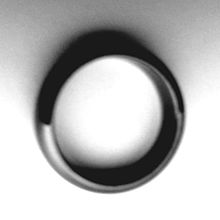
Some members of the asexual customs opt to vesture a blackness ring on the centre finger of their correct hand as a form of identification.[seventy]
An academic work dealing with the history of the asexual customs is presently lacking.[71] Although a few private sites for people with niggling or no sexual want existed on the Internet in the 1990s,[72] scholars country that a customs of self-identified asexuals coalesced in the early 21st century, aided by the popularity of online communities.[73] Volkmar Sigusch stated that "Groups such as 'Leather Spinsters' defended asexual life confronting the pressure of culture" and that "Geraldin van Vilsteren created the 'Nonlibidoism Order' in the Netherlands, while Yahoo offered a grouping for asexuals, 'Haven for the Human Amoeba.'"[72] The Asexual Visibility and Education Network (AVEN) is an organization founded by American asexuality activist David Jay in 2001 that focuses on asexuality issues.[4] Its stated goals are "creating public acceptance and discussion of asexuality and facilitating the growth of an asexual community".[4] [12]
For some, existence a office of a customs is an of import resource because they ofttimes written report having felt ostracized.[25] Although online communities exist, amalgamation with online communities vary. Some question the concept of online community, while others depend on the online asexual community heavily for support. Elizabeth Abbott posits that there has always been an asexual element in the population, but that asexual people kept a low profile. While the failure to consummate marriage was seen equally an insult to the sacrament of wedlock in medieval Europe, and has sometimes been used as grounds for divorce or to rule a spousal relationship void, asexuality, unlike homosexuality, has never been illegal, and it has usually gone unnoticed. However, in the 21st century, the anonymity of online communication and full general popularity of social networking online has facilitated the formation of a community built around a mutual asexual identity.[74]
Communities such as AVEN tin can be beneficial to those in search of answers to solve a crisis of identity with regard to their possible asexuality. Individuals go through a series of emotional processes that end with their identifying with the asexual community. They first realize that their sexual attractions differ from those of well-nigh of society. This departure leads to questioning whether the way they feel is adequate, and possible reasons for why they experience this fashion. Pathological beliefs tend to follow, in which, in some cases, they may seek medical assistance because they feel they accept a disease. Cocky-understanding is usually reached when they find a definition that matches their feelings. Asexuality communities provide back up and information that allows newly identified asexuals to movement from self-clarification to identifying on a communal level, which tin be empowering, considering they now have something to associate with, which gives normality to this overall socially-isolating situation.[75]
Asexual organizations and other Net resources play a central role in informing people well-nigh asexuality. The lack of enquiry makes it hard for doctors to understand the causation. Like with whatsoever sexual orientation, nigh people who are asexual are self-identified. This tin can be a trouble when asexuality is mistaken for an intimacy or relationship trouble or for other symptoms that do non define asexuality. There is also a meaning population that either does not understand or does non believe in asexuality, which adds to the importance of these organizations to inform the general population; notwithstanding, due to the lack of scientific fact on the subject, what these groups promote as data is often questioned.
On June 29, 2014, AVEN organized the 2d International Asexuality Conference, as an chapter WorldPride event in Toronto. The first was held at the 2012 World Pride in London.[76] The 2nd such upshot, which was attended by effectually 250 people, was the largest gathering of asexuals to date.[77] The conference included presentations, discussions, and workshops on topics such every bit research on asexuality, asexual relationships, and intersecting identities.
Symbols

In 2009, AVEN members participated in the get-go asexual entry into an American pride parade when they walked in the San Francisco Pride Parade.[78] In August 2010, after a flow of fence over having an asexual flag and how to fix a organisation to create one, and contacting as many asexual communities as possible, a flag was appear as the asexual pride flag by one of the teams involved. The final flag had been a popular candidate and had previously seen employ in online forums outside of AVEN. The final vote was held on a survey system outside of AVEN where the primary flag creation efforts were organized. The flag colors have been used in artwork and referenced in articles well-nigh asexuality.[79] The flag consists of four horizontal stripes: black, grey, white, and purple from height to bottom. The black stripe represents asexuality, the grayness stripe representing the grey-area between sexual and asexual, the white stripe sexuality, and the majestic stripe community.[80] [81] [82]
Ace Calendar week
Ace Week (formerly Asexual Awareness Week) occurs on the last total calendar week in October. It is an awareness menses that was created to gloat and bring awareness to asexuality (including grey asexuality).[83] [84] Information technology was founded by Sara Beth Brooks in 2010.[85] [86]
International Asexuality Day
International Asexuality Mean solar day (IAD) is an almanac commemoration of the asexuality community that takes identify on 6 April.[87] The intention for the day is "to place a special accent on the international customs, going beyond the anglophone and Western sphere that has so far had the virtually coverage".[88] An international commission spent a little under a year preparing the event, too every bit publishing a website and press materials.[89] This committee settled on the date of 6 April to avoid clashing with as many significant dates around the world as possible, although this date is subject to review and may modify in future years.[88] [xc]
The first International Asexuality Day was celebrated in 2021 and involved asexuality organisations from at least 26 unlike countries.[87] [91] [92] Activities included virtual meetups, advocacy programs both online and offline, and the sharing of stories in various fine art-forms.[93]
Religion
Studies have constitute no pregnant statistical correlation between religion and asexuality,[94] with asexuality occurring with equal prevalence in both religious and irreligious individuals.[94] Yet, asexuality is not uncommon amid celibate clergy, since others are more than likely to be discouraged by vows of guiltlessness.[95] In Aicken, Mercer, and Cassell's study, a college proportion of Muslim respondents than Christian ones reported that they did not experience whatever form of sexual attraction.[94]
Considering of the relatively recent application of the term asexuality, most religions do not have clear stances on it.[96] [ unreliable source? ] In Matthew nineteen:11–12, Jesus mentions "For at that place are eunuchs who were built-in that fashion, and there are eunuchs who take been fabricated eunuchs by others – and at that place are those who choose to live similar eunuchs to the sake of the kingdom of heaven."[97] Some biblical exegetes have interpreted the "eunuchs who were born that way" as including asexuals.[97] [98]
Christianity has traditionally revered celibacy (which is non the same as asexuality); the apostle Paul, writing as a celibate, has been described by some writers as asexual.[99] He writes in 1 Corinthians 7:6–nine,
I wish that all men were as I am. Merely each man has his own gift from God; one has this gift, another has that. At present to the unmarried and the widows I say: It is proficient for them to stay unmarried, every bit I am. Just if they cannot control themselves, they should marry, for it is ameliorate to marry than to burn with passion.
Discrimination and legal protections

Asexuals marching in a pride parade in London
A 2012 study published in Group Processes & Intergroup Relations reported that asexuals are evaluated more than negatively in terms of prejudice, dehumanization and bigotry than other sexual minorities, such as gay men, lesbians and bisexuals. Both homosexual and heterosexual people thought of asexuals equally non simply common cold, but also animalistic and unrestrained.[100] A dissimilar study, all the same, institute little evidence of serious discrimination against asexuals considering of their asexuality.[101] Asexual activist, author, and blogger Julie Decker has observed that sexual harassment and violence, such as cosmetic rape, commonly victimizes the asexual community.[102] Sociologist Mark Carrigan sees a eye ground, arguing that while asexuals practice oft feel discrimination, it is non of a phobic nature simply "more than almost marginalization because people genuinely don't understand asexuality."[103]
Asexuals also face prejudice from the LGBT community.[47] [102] Many LGBT people presume that anyone who is not homosexual or bisexual must be straight[47] and oft exclude asexuals from their definitions of queer.[47] Although many well-known organizations devoted to aiding LGBTQ communities exist,[47] these organizations mostly do not reach out to asexuals[47] and do not provide library materials about asexuality.[47] Upon coming out as asexual, activist Sara Beth Brooks was told by many LGBT people that asexuals are mistaken in their self-identification and seek undeserved attention inside the social justice movement.[102] Other LGBT organizations, such as The Trevor Project and the National LGBTQ Job Strength, explicitly include asexuals because they are non-heterosexual and tin can therefore be included in the definition of queer.[104] [105] Some organizations now add together an A to the LGBTQ acronym to include asexuals; all the same, this is still a controversial topic in some queer organizations.[106]
In some jurisdictions, asexuals have legal protections. While Brazil bans since 1999 whatever pathologization or attempted treatment of sexual orientation by mental health professionals through the national ethical lawmaking,[107] the U.S. state of New York has labeled asexuals equally a protected course.[108] Withal, asexuality does not typically attract the attention of the public or major scrutiny; therefore, it has not been the bailiwick of legislation equally much equally other sexual orientations accept.[37]
In the media

Asexual representation in the media is express and rarely openly acknowledged or confirmed past creators or authors.[109] In works composed prior to the kickoff of the twenty-kickoff century, characters are more often than not automatically causeless to be sexual[110] and the existence of a character's sexuality is usually never questioned.[110] Sir Arthur Conan Doyle portrayed his character Sherlock Holmes every bit what would today exist classified as asexual,[95] with the intention to characterize him as solely driven by intellect and immune to the desires of the flesh.[95] The Archie Comics character Jughead Jones was likely intended by his creators as an asexual foil to Archie'due south excessive heterosexuality, but, over the years, this portrayal shifted, with diverse iterations and reboots of the serial implying that he is either gay or heterosexual.[95] [111] In 2016, he was confirmed to be asexual in the New Riverdale Jughead comics.[111] The writers of the 2017 television evidence Riverdale, based on the Archie comics, chose to depict Jughead equally a heterosexual despite pleas from both fans and Jughead actor Cole Sprouse to retain Jughead's asexuality and allow the asexual community to exist represented alongside the gay and bisexual communities, both represented in the testify.[112] This determination sparked conversations about deliberate asexual erasure in the media and its consequences, specially on younger viewers.[113]
Anthony Bogaert has classified Gilligan, the eponymous character of the 1960s television series Gilligan'south Island, as asexual.[95] Bogaert suggests that the producers of the show likely portrayed him in this way to make him more relatable to immature male viewers of the show who had non yet reached puberty and had therefore presumably not yet experienced sexual desire.[95] Gilligan's asexual nature also immune the producers to orchestrate intentionally comedic situations in which Gilligan spurns the advances of attractive females.[95] Films and television shows ofttimes feature bonny, simply seemingly asexual, female person characters who are "converted" to heterosexuality by the male person protagonist past the end of the production.[95] These unrealistic portrayals reflect a heterosexual male belief that all asexual women secretly desire men.[95]
Asexuality as a sexual identity, rather than as a biological entity, became more widely discussed in the media in the beginning of the twenty-first century.[109] The Fox Network serial House represented an "asexual" couple in the episode "Amend Half". However, this representation has been questioned by members of the asexual customs (including AVEN founder, David Jay) due to the episode concluding in the reveal that the human being simply had a pituitary tumor that reduced his sex drive, and the woman was only pretending to exist asexual to please him.[114] This led to controversy over the representation and a modify.org petition for Fox Network to reconsider how it represents asexual characters in the futurity, stating information technology "represented asexuality very poorly by attributing it to both medical disease and deception."[114] Children'south animated goggle box series SpongeBob SquarePants was under speculation (2002) and afterwards controversy (2005) because of claims that SpongeBob and his all-time friend, Patrick, are gay.[115] [116] This prompted the creator, Stephen Hillenburg, to clarify on both occasions that he does non consider them gay or heterosexual, but rather asexual.[117] [118] [119] He likewise linked SpongeBob'south ability to reproduce asexually by "budding" to further explain that the character doesn't necessarily need relationships.[120]
The Netflix series BoJack Horseman revealed in the cease of the third season that Todd Chavez, one of the main characters, is asexual. This has been further elaborated in the fourth flavour of the series and has been generally well accepted past the asexual community for its methods of positive representation.[121]
Come across also
- Asociality: a lack of interest in social relationships in general
- Antisexualism: the views of someone who is antagonistic towards sexuality
- Media portrayal of asexuality
- Platonic beloved: a non-romantic/non-sexual affectionate relationship
- Sexless marriage: a matrimony in which little or no sex is performed
- Sexual anorexia: a loss of "appetite" for romantic-sexual interaction
- Timeline of asexual history
- Kinsey scale: a scale for human being sexuality with X indicating "no socio-sexual contacts or reactions"
Notes
- ^ This denominator is mistakenly given equally 25 in the abstruse of Cranney'southward initial study. The number of individuals who reported no sexual attraction in wave 3 was 14, according to Tabular array ii, the first paragraph of the section "Multivariate Analysis", and the following quote from Cranney's subsequent commentary: "Specifically, of the 14 people who indicated 'no sexual attraction' in Wave Three, only three went on to practise so in Wave IV (Tabular array 2)."[52]
References
- ^ Robert 50. Crooks; Karla Baur (2016). Our Sexuality. Cengage Learning. p. 300. ISBN978-1305887428 . Retrieved January iv, 2017.
- ^ a b c Katherine M. Captain (2015). Hooking Up: The Psychology of Sex and Dating. ABC-CLIO. p. 32. ISBN978-1610699518 . Retrieved January iv, 2017.
- ^ Kelly, Gary F. (2004). "Chapter 12". Sexuality Today: The Human being Perspective (seven ed.). McGraw-Colina. p. 401. ISBN978-0-07-255835-7Asexuality is a condition characterized past a low interest in sex activity.
{{cite book}}: CS1 maint: postscript (link) - ^ a b c d e f g h i Marshall Cavendish, ed. (2010). "Asexuality". Sexual activity and Gild. Vol. 2. Marshall Cavendish. pp. 82–83. ISBN978-0-7614-7906-2 . Retrieved July 27, 2013.
- ^ a b c d e f Bogaert, AF (April 2015). "Asexuality: What Information technology Is and Why It Matters". The Journal of Sex Research. 52 (4): 362–379. doi:x.1080/00224499.2015.1015713. PMID 25897566. S2CID 23720993.
- ^ Scherrer, Kristin (2008). "Coming to an Asexual Identity: Negotiating Identity, Negotiating Desire". Sexualities. eleven (5): 621–641. doi:10.1177/1363460708094269. PMC2893352. PMID 20593009.
- ^ a b c d Margaret Jordan Halter; Elizabeth Thou. Varcarolis (2013). Varcarolis' Foundations of Psychiatric Mental Wellness Nursing. Elsevier Wellness Sciences. p. 382. ISBN978-1-4557-5358-ane . Retrieved May 7, 2014.
- ^ a b c DePaulo, Bella (September 26, 2011). "ASEXUALS: Who Are They and Why Are They Important?". Psychology Today . Retrieved December xiii, 2011.
- ^ The American Heritage Dictionary of the English language Linguistic communication (3d ed. 1992), entries for celibacy and thence forbearance.
- ^ "Sexual orientation, homosexuality and bisexuality". American Psychological Clan. Retrieved March 30, 2013.
- ^ a b c d eastward f g h i j yard l Prause, Nicole; Cynthia A. Graham (August 2004). "Asexuality: Classification and Label" (PDF). Athenaeum of Sexual Behavior. 36 (three): 341–356. doi:x.1007/s10508-006-9142-3. PMID 17345167. S2CID 12034925. Archived from the original (PDF) on September 27, 2007. Retrieved Baronial 31, 2007.
- ^ a b Swash, Rosie (February 25, 2012). "Among the asexuals". The Guardian . Retrieved Feb 2, 2013.
- ^ a b Decker, Julie South. (2015). The Invisible Orientation: An Introduction to Asexuality. Simon and Schuster. ISBN9781510700642 . Retrieved April twenty, 2019. [ page needed ]
- ^ One thousand thousand Barker (2012). Rewriting the Rules: An Integrative Guide to Love, Sex and Relationships. Routledge. p. 69. ISBN978-0415517621 . Retrieved Feb viii, 2016.
- ^ Shira Tarrant (2015). Gender, Sex, and Politics: In the Streets and Between the Sheets in the 21st Century. Routledge. pp. 254–256. ISBN978-1317814764 . Retrieved Feb 8, 2016.
- ^ a b c d eastward f yard Karli June Cerankowski; Megan Milks (2014). Asexualities: Feminist and Queer Perspectives. Routledge. pp. 89–93. ISBN978-1-134-69253-viii . Retrieved July three, 2014.
- ^ a b c Bogaert, Anthony F. (2006). "Toward a conceptual agreement of asexuality". Review of General Psychology. 10 (3): 241–250. doi:10.1037/1089-2680.x.3.241. S2CID 143968129. Archived from the original on Jan xiv, 2012. Retrieved August 31, 2007.
- ^ a b c d Nancy L. Fischer; Steven Seidman (2016). Introducing the New Sexuality Studies. Routledge. p. 183. ISBN978-1317449188 . Retrieved Jan 4, 2017.
- ^ a b "Overview". The Asexual Visibility and Education Network. 2008. Retrieved January vi, 2016.
- ^ a b c d due east f Christina Richards; Meg Barker (2013). Sexuality and Gender for Mental Health Professionals: A Practical Guide. SAGE. pp. 124–127. ISBN978-one-4462-9313-three . Retrieved July iii, 2014.
- ^ a b Westphal, Sylvia Heathen. "Feature: Glad to be asexual". New Scientist. Archived from the original on December nineteen, 2007. Retrieved Nov xi, 2007.
- ^ a b c Bridgeman, Shelley (August 5, 2007). "No sex please, we're asexual". The New Zealand Herald . Retrieved September 16, 2011.
- ^ Yule, Morag A.; Brotto, Lori A.; Gorzalka, Boris B. (2014). "Sexual fantasy and masturbation amid asexual individuals". The Canadian Periodical of Human being Sexuality. 23 (2): 89–95. doi:ten.3138/cjhs.2409. S2CID 4091448.
- ^ a b c d Carrigan, Mark (Baronial 2011). "In that location's More to Life Than Just Sex? Difference and Commonality Within the Asexual Customs". Sexualities. 14 (4): 462–478. doi:10.1177/1363460711406462. S2CID 146445274.
- ^ a b MacNeela, Pádraig; Irish potato, Aisling (December thirty, 2014). "Freedom, Invisibility, and Community: A Qualitative Study of Cocky-Identification with Asexuality". Athenaeum of Sexual Behavior. 44 (3): 799–812. doi:10.1007/s10508-014-0458-0. ISSN 0004-0002. PMID 25548065. S2CID 23757013.
- ^ Adler, Melissa (2010). "Meeting the Needs of LGBTIQ Library Users and Their Librarians: A Written report of User Satisfaction and LGBTIQ Collection Development in Academic Libraries". In Greenblatt, Ellen (ed.). Serving LGBTIQ Library and Archives Users. North Carolina: McFarland & Company. ISBN978-0-7864-4894-four.
- ^ a b c Chasin, CJ DeLuzio (2015). "Making Sense in and of the Asexual Community: Navigating Relationships and Identities in a Context of Resistance". Periodical of Community & Applied Social Psychology. 25 (2): 167–180. doi:ten.1002/casp.2203. ISSN 1099-1298.
- ^ a b Justin J. Lehmiller (2017). The Psychology of Human Sexuality. John Wiley & Sons. p. 250. ISBN978-1119164708 . Retrieved Nov 29, 2017.
- ^ Etaugh, Claire A.; Bridges, Judith S. (October 16, 2017). Women'southward Lives: A Psychological Exploration, Fourth Edition. Taylor & Francis. ISBN978-1-315-44938-eight.
{{cite book}}: CS1 maint: engagement and year (link) - ^ a b Smith, Southward. E. (August 21, 2012). "Asexuality always existed, you but didn't notice it". The Guardian . Retrieved March eleven, 2013.
- ^ LeBreton, Marianne East. (2014). Bogaert, Anthony F. (ed.). "Understanding Asexuality". QED: A Journal in GLBTQ Worldmaking. one (iii): 175–177. doi:10.14321/qed.1.three.0175. ISSN 2327-1574. JSTOR 10.14321/qed.1.3.0175.
- ^ Poston, Dudley 50.; Baumle, Amanda M. (2010). "Patterns of asexuality in the United States". Demographic Inquiry. 23: 509–530. doi:10.4054/DemRes.2010.23.18. ISSN 1435-9871. JSTOR 26349603.
- ^ a b Kinsey, Alfred C. (1948). Sexual Beliefs in the Human Male. W.B. Saunders. ISBN978-0-253-33412-1.
- ^ a b c Kinsey, Alfred C. (1953). Sexual Beliefs in the Homo Female person. W.B. Saunders. ISBN978-0-253-33411-4.
- ^ Mary Zeiss Stange; Carol M. Oyster; Jane Eastward. Sloan (February 23, 2011). Encyclopedia of Women in Today'southward World. SAGE Publications. p. 158. ISBN978-1-4129-7685-5 . Retrieved July 27, 2013.
- ^ Wellings, K. (1994). Sexual Behaviour in U.k.: The National Survey of Sexual Attitudes and Lifestyles. Penguin Books.
- ^ a b Bogaert, Anthony F. (2004). "Asexuality: prevalence and associated factors in a national probability sample". Journal of Sex activity Research. 41 (3): 279–87. doi:10.1080/00224490409552235. PMID 15497056. S2CID 41057104.
- ^ a b c Aicken, Catherine R. H.; Mercer, Catherine H.; Cassell, Jackie A. (May i, 2013). "Who reports absence of sexual attraction in United kingdom of great britain and northern ireland? Evidence from national probability surveys". Psychology & Sexuality. 4 (2): 121–135. doi:10.1080/19419899.2013.774161. ISSN 1941-9899. S2CID 62275856.
- ^ a b c d due east Bogaert, A. F. (2015). "Asexuality: What Information technology Is and Why It Matters". Journal of Sex Research. 52 (iv): 362–379. doi:10.1080/00224499.2015.1015713. PMID 25897566. S2CID 23720993.
- ^ "1 in 2 immature people say they are not 100% heterosexual" (PDF). August sixteen, 2015. Come across the full poll results. Retrieved December 31, 2018.
- ^ a b c Chasin, CJ DeLuzio (2013). "Reconsidering Asexuality and Its Radical Potential" (PDF). Feminist Studies. 39 (ii): 405. doi:10.1353/fem.2013.0054. S2CID 147025548. Retrieved Apr 29, 2014.
- ^ Brotto, L. A.; Yule, G. A.; Gorzalka, B..B. (2015). "Asexuality: An Extreme Variant of Sexual Want Disorder?". The Journal of Sexual Medicine. 12 (3): 646–660. doi:10.1111/jsm.12806. PMID 25545124. S2CID 30504509.
- ^ Karli June Cerankowski; Megan Milks (2014). Asexualities: Feminist and Queer Perspectives. Routledge. p. 246. ISBN978-i-134-69253-8 . Retrieved July iii, 2014.
- ^ a b c Elisabetta Ruspini; Megan Milks (2013). Diversity in family unit life. Policy Printing. pp. 35–36. ISBN978-1447300939 . Retrieved January 4, 2017.
- ^ a b Nurius, Paula (1983). "Mental Wellness Implications of Sexual Orientation". The Periodical of Sex activity Research. xix (2): 119–136. doi:10.1080/00224498309551174.
- ^ Yule, Morag A.; Brotto, Lori A.; Gorzalka, Boris B. (2013). "Mental Wellness and Interpersonal Functioning in Self-Identified Asexual Men and Women". Psychology & Sexuality. 4 (2): 136–151. doi:ten.1080/19419899.2013.774162. S2CID 147120909.
- ^ a b c d e f g Decker, Julie Sondra (2015). The Invisible Orientation: An Introduction to Asexuality. New York City, New York: Skyhorse Publishing. ISBN978-1-5107-0064-2.
- ^ Over, Ray; Koukounas, Eric (1995). "Habituation of Sexual Arousal: Product and Process". Annual Review of Sexual activity Enquiry. half-dozen (one): 187–223. doi:10.1080/10532528.1995.10559905 (inactive October 31, 2021).
{{cite journal}}: CS1 maint: DOI inactive as of October 2021 (link)
Cited from: Kelly, Gary F. (2004). Sexuality Today: The Homo Perspective (vii ed.). McGraw-Loma. p. 401. ISBN978-0-07-255835-7. - ^ Meyer, Doug (2017). "The Disregarding of Heteronormativity: Emphasizing a Happy Queer Adulthood and Localizing Anti-Queer Violence to Boyish Schools". Sexuality Inquiry & Social Policy. 14 (3): 331–344. doi:ten.1007/s13178-016-0272-vii. S2CID 151482192.
- ^ Garcia-Falgueras, A; Swaab, DF (2010). Sexual hormones and the brain: an essential alliance for sexual identity and sexual orientation. Endocr Dev. Endocrine Development. Vol. 17. pp. 22–35. doi:10.1159/000262525. ISBN978-iii-8055-9302-i. PMID 19955753.
- ^ Brotto, 50. A.; Yule, M. (2016). "Asexuality: Sexual Orientation, Paraphilia, Sexual Dysfunction, or None of the In a higher place?". Archives of Sexual Behavior. 46 (iii): 619–627. doi:10.1007/s10508-016-0802-7. PMID 27542079. S2CID 207092428.
- ^ a b Cranney, Stephen (2016). "Does Asexuality Meet the Stability Criterion for a Sexual Orientation?". Archives of Sexual Behavior. 46 (3): 637–638. doi:10.1007/s10508-016-0887-z. PMID 27815642. S2CID 40119928.
- ^ Cranney, Stephen (2016). "The Temporal Stability of Lack of Sexual Attraction across Young Machismo". Archives of Sexual Behavior. 45 (three): 743–749. doi:10.1007/s10508-015-0583-4. PMC5443108. PMID 26228992.
- ^ a b Karli June Cerankowski; Megan Milks (2014). Asexualities: Feminist and Queer Perspectives. Routledge. p. 244. ISBN978-1-134-69253-8 . Retrieved January four, 2017.
- ^ "Asexual and Autoerotic Women: Ii Invisible Groups" found in ed. Gochros, H. 50.; J. Due south. Gochros (1977). The Sexually Oppressed. Associated Printing. ISBN 978-0-8096-1915-3
- ^ Karli June Cerankowski; Megan Milks (2014). Asexualities: Feminist and Queer Perspectives. Routledge. p. 113. ISBN978-i-134-69253-eight . Retrieved Jan 4, 2017.
- ^ Storms, Michael D. (1980). "Theories of Sexual Orientation" (PDF). Journal of Personality and Social Psychology. 38 (5): 783–792. doi:10.1037/0022-3514.38.5.783.
- ^ Storms, 1000. D. (1979). Sexual orientation and self-perception. ed. Pliner, Patricia et al. Advances in the Report of Communication and Affect. Volume five: Perception of Emotion in Self and Others Plenum Printing
- ^ Aleksondra Hultquist; Elizabeth J. Mathews (2016). New Perspectives on Delarivier Manley and Eighteenth Century Literature: Power, Sex, and Text. Routledge. p. 123. ISBN978-1317196921 . Retrieved January 4, 2017.
- ^ a b Karli June Cerankowski; Megan Milks (2014). Asexualities: Feminist and Queer Perspectives. Routledge. pp. 1–410. ISBN978-1-134-69253-8 . Retrieved January 4, 2017.
- ^ Myers, David K. (2010). Psychology (9th ed.). New York: Worth Publishers. p. 474. ISBN978-one-4292-1597-8.
- ^ a b Przybylo, Ela. "Masculine Dubiety and Sexual Wonder: Asexually-Identified Men Talk About Their (A)sexualities" from Karli June Cerankowski and Megan Milks, eds., Asexualities: Feminist and Queer Perspectives (Routledge, 2014), 225-246.
- ^ a b c Przybylo, Ela (2011). Asexuality and the Feminist Politics of 'Not Doing It' (MA thesis). Edmonton, Alberta: University of Alberta. doi:10.7939/R3RB04.
- ^ Przybylo, Ela (2013). "Producing Facts: Empirical Asexuality and the Scientific Report of Sexual practice". Feminism & Psychology. 23 (2): 224–242. doi:10.1177/0959353512443668. S2CID 144394132.
- ^ Przybylo, Ela (2019). Asexual erotics : intimate readings of compulsory sexuality. Columbus: Ohio Country University. pp. one–32. ISBN978-0-8142-1404-6. OCLC 1096288008.
- ^ a b c Hawkins Owen, Ianna (2014). Asexualities : feminist and queer perspectives. Cerankowski, Karli June., Milks, Megan. New York. ISBN978-0-415-71442-6. OCLC 863044056.
- ^ Owen, Ianna Hawkins (Nov 2018). "Still, zilch: Mammy and blackness asexual possibility". Feminist Review. 120 (1): 70–84. doi:10.1057/s41305-018-0140-nine. ISSN 0141-7789. S2CID 149999756.
- ^ Kim, Eunjung (2014). Asexualities : feminist and queer perspectives. Cerankowski, Karli June., Milks, Megan. New York. ISBN978-0-415-71442-half dozen. OCLC 863044056.
- ^ a b Bogaert, Anthony F (2006). "Toward a Conceptual Understanding of Asexuality". Review of General Psychology. x (3): 241–250. doi:10.1037/1089-2680.10.3.241. S2CID 143968129.
- ^ Chasin, CJ DeLuzio (2013). "Reconsidering Asexuality and Its Radical Potential". Feminist Studies. 39 (two): 405–426. doi:10.1353/fem.2013.0054. S2CID 147025548.
- ^ Carrigan, Marking; Gupta, Kristina; Morrison, Todd K. (2015). Asexuality and Sexual Normativity: An Anthology. Routledge. ISBN978-0-415-73132-four.
- ^ a b Volkmar Sigusch. "Sexualitäten: Eine kritische Theorie in 99 Fragmenten". 2013. Campus Verlag [de].
- ^ Abbie East. Goldberg (2016). The SAGE Encyclopedia of LGBTQ Studies. SAGE Publications. p. 92. ISBN978-1483371290 . Retrieved Oct five, 2017.
[...] The sociological literature has stressed the novelty of asexuality equally a distinctive form of social identification that emerged in the early 21st century.
- ^ Duenwald, Mary (July ix, 2005). "For Them, Just Proverb No Is Easy". The New York Times . Retrieved September 17, 2007.
- ^ Carrigan, Mark (2011). "There'southward more to life than sex activity? Differences and commonality inside the asexual community". Sexualities. 14 (four): 462–478. doi:10.1177/1363460711406462. S2CID 146445274.
- ^ Shira Tarrant (June xix, 2015). Gender, Sexual practice, and Politics: In the Streets and Betwixt the Sheets in the 21st Century. Taylor & Francis. pp. 278–. ISBN978-one-317-81475-7.
- ^ "World Pride Toronto: Asexuals march in biggest numbers however". Toronto Star. June 23, 2014. Retrieved October 6, 2014.
- ^ Anneli, Rufus (June 22, 2009). "Stuck. Asexuals at the Pride Parade". Psychology Today . Retrieved July 15, 2013.
- ^ "Asexuality – Redefining Love and Sexuality". recultured. January 9, 2012. Retrieved August 7, 2012.
- ^ Bilić, Bojan; Kajinić, Sanja (2016). Intersectionality and LGBT Activist Politics: Multiple Others in Republic of croatia and Serbia. Springer. pp. 95–96.
- ^ Decker, Julie. The Invisible Orientation: An Introduction to Asexuality. Skyhorse.
- ^ "Asexual". UCLA Lesbian Gay Bisexual Transgender Resources center. Archived from the original on September 4, 2017. Retrieved June 25, 2018.
- ^ Kumar, Shikha (March 18, 2017). "Run across Republic of india's newest sexual minority: The asexuals". Hindustan Times . Retrieved September 8, 2017.
- ^ "AAW – About Us". asexualawarenessweek.com . Retrieved January three, 2016.
- ^ Exton, Robyn (Nov fourteen, 2016). "Aces Show Their Hand – What Is Asexuality And Why You Should Know About It". HuffPost . Retrieved September 8, 2017.
- ^ "About [prerelease]". asexualawarenessweek.com . Retrieved September 4, 2017.
- ^ a b "International Asexuality Day". International Asexuality Day (IAD).
- ^ a b "FAQ". International Asexuality Day (IAD).
- ^ "Redefining Perceptions Of Asexuality With Yasmin Benoit". noctismag.com.
- ^ Flood, Rebecca (April 6, 2021). "Asexual Significant every bit Commencement International Asexuality Day Celebrated Around the Earth". Newsweek. Archived from the original on April 6, 2021. Retrieved April 7, 2021.
- ^ Waters, Jamie (March 21, 2021). "'I don't want sexual activity with anyone': the growing asexuality move". The Guardian. Archived from the original on April i, 2021. Retrieved Apr 7, 2021.
- ^ O'Dell, Liam (April half-dozen, 2021). "What is International Asexuality 24-hour interval?". The Contained. Archived from the original on April half-dozen, 2021. Retrieved Apr 7, 2021.
- ^ "In Nepal's growing queer movement, here's how asexuals are trying to amplify their voice". kathmandupost.com . Retrieved Apr seven, 2021.
- ^ a b c Aicken, Catherine R. H.; Mercer, Catherine H.; Cassell, Jackie A. (September 7, 2015). "Who reports absenteeism of sexual attraction in Britain? Evidence from national probability surveys". In Carrigan, Mark; Gupta, Kristina; Morrison, Todd Yard. (eds.). Asexuality and Sexual Normativity: An Anthology. New York Metropolis, New York and London, England: Routledge. pp. 22–27. ISBN978-0-415-73132-4.
- ^ a b c d due east f m h i j Bogaert, Anthony (2012). Agreement Asexuality. Lanham, Maryland: Rowman and Littlefield Publishers, Inc. pp. 36–39. ISBN978-1-4422-0099-nine.
- ^ "Asexuality and Christianity" (PDF). Asexual Awareness Week. Archived from the original (PDF) on October 29, 2013. Retrieved January x, 2018.
- ^ a b Kaoma, Kapya (2018). Christianity, Globalization, and Protective Homophobia: Autonomous Contestation of Sexuality in Sub-Saharan Africa. Boston, Massachusetts: Palgrave Macmillan. pp. 159–160. ISBN978-iii-319-66341-8.
- ^ Cole, William Graham (2015) [1955]. Sex in Christianity and Psychoanalysis. Routledge Library Editions: Psychoanalysis. New York Urban center, New York and London, England: Routledge. p. 177. ISBN978-1138951792.
- ^ Zuckerman, Phil (2003). An Invitation to Sociology of Religion. New York Metropolis, New York and London, England: Routledge. p. 111. ISBN978-0-415-94125-9.
- ^ MacInnis, Cara C.; Hodson, Gordon (2012). "Intergroup bias toward 'Grouping 10': Evidence of prejudice, dehumanization, abstention, and discrimination against asexuals". Group Processes & Intergroup Relations. 15 (half-dozen): 725–743. doi:10.1177/1368430212442419. S2CID 3056711.
- ^ Gazzola, Stephanie B, and Melanie A. Morrison. "Asexuality: An emergent sexual orientation". Sexual Minority Research in the New Millennium.
- ^ a b c Mosbergen, Dominique (June 20, 2013). "Battling Asexual Discrimination, Sexual Violence, and Corrective Rape". HuffPost . Retrieved August ii, 2013.
- ^ Wallis, Lucy (January 17, 2012). "What is it like to be asexual?". BBC News. BBC. Retrieved Jan one, 2014.
- ^ The Trevor Project - FAQ about asexuality, The Trevor Project website. Retrieved April four, 2018.
- ^ "The a is Hither to Stay". April 30, 2013. Archived from the original on March 10, 2018. Retrieved April iv, 2018.
- ^ Mosbergen, Dominique (June 21, 2013). "LGBT, Asexual Communities Disharmonism over Ace Inclusion". HuffPost.
- ^ Psychiatrist Jairo Bouer talks about the "collateral effects" of "gay cure" neb Archived Jan fifteen, 2014, at the Wayback Machine (in Portuguese)
- ^ The Sexual Orientation Not-Discrimination Act ("SONDA") (Country of New York, Role of the Attorney Full general, Civil Rights Agency, 2008) (possibly written after stated copyright date, Attorney General being stated as Eric T. Schneiderman)
- ^ a b Kelemen, Erick. "Asexuality". Encyclopedia of Sexual practice and Gender. Ed. Fedwa Malti-Douglas. Vol. 1. Detroit: Macmillan Reference USA, 2007. 103. Gale Virtual Reference Library. Web. May 2, 2016.
- ^ a b Jackson, Stevi, and Sue Scott. Theorizing Sexuality. Maidenhead: Open, 2010. Web. May ii, 2016.
- ^ a b "Archie Comic Reveals Jughead Is Asexual". Vulture. February 8, 2016. Retrieved December 14, 2017.
- ^ "Cole Sprouse Is Bummed That RIVERDALE'due south Jughead Isn't Asexual | Nerdist". Nerdist. January 27, 2017. Archived from the original on June 26, 2018. Retrieved September 9, 2018.
- ^ Revanche, Jonno. "'Riverdale's' Asexual Erasure Can Be More Harmful Than Yous Think". Teen Faddy . Retrieved September 9, 2018.
- ^ a b Clark-Flory, Tracy (January 31, 2012). ""Business firm" gets asexuality wrong". Salon . Retrieved September viii, 2017.
- ^ "US right attacks SpongeBob video". January 20, 2005. Retrieved November 25, 2019.
- ^ "The long and speculative history of gay characters on children's TV shows". The Telegraph. January 28, 2016. ISSN 0307-1235. Archived from the original on January eleven, 2022. Retrieved November 25, 2019.
- ^ "Campsite cartoon star 'is not gay'". Oct 9, 2002. Retrieved November 25, 2019.
- ^ "SpongeBob Asexual, Not Gay: Creator". People . Retrieved November 25, 2019.
- ^ "SpongeBob is asexual, says creator". Asexual Visibility and Instruction Network . Retrieved November 25, 2019.
- ^ Writers: Jay Lender, William Reiss, David Fain (March 8, 2001). "Pressure". SpongeBob SquarePants. Season two. Episode 32a. Nickelodeon.
- ^ Kliegman, Julie. "Todd'southward Asexuality On 'BoJack' Isn't A Perfect Depiction, But It'southward Made Me Experience Understood". Bustle . Retrieved April xxx, 2019.
Further reading
- Bogaert, Anthony F. (August 9, 2012). Understanding Asexuality. Rowman & Littlefield Publishers. ISBN978-i-4422-0101-9 . Retrieved July 27, 2013.
- Decker, Julie (September ii, 2014). The Invisible Orientation: An Introduction to Asexuality. Carrel Books. ISBN978-1631440021 . Retrieved September 28, 2014.
- "Nosotros're married, nosotros just don't have sex", UK Guardian, September eight, 2008
- Asexuals leave the cupboard, observe community – SFGate.com
- "Asexuality", article by Mark Carrigan, in: The SAGE Encyclopedia of LGBTQ Studies 1 (A-G).
- Rle Eng. 'Leather Spinsters and Their Degrees of Asexuality' St.Mary Pub. Co. of Houston, 1998.
- Geraldine Levi Joosten-van Vilsteren, Edmund Fortuin, David Walker, and Christine Stone, Nonlibidoism: The Curt Facts. United kingdom. ISBN 1447575555
- Chen, Angela (September 15, 2020). Ace: What Asexuality Reveals Almost Desire, Society, and the Meaning of Sex activity. Beacon Printing. ISBN 9780807013793
External links
 Media related to Man asexuality at Wikimedia Commons
Source: https://en.wikipedia.org/wiki/Asexuality
0 Response to "Asexual Erotics: Intimate Readings of Compulsory Sexuality"
Post a Comment